

Make Claims Audit Proof: HSA vs FSA for U.S. Chiropractic Paperwork
Yes, both HSA and FSA funds generally cover chiropractic care, because the IRS treats chiropractor fees as qualified medical expenses. The catch is that your visits need to treat an actual diagnosed condition, not just serve as routine tune-ups or relaxation care. Get the documentation right, and either account pays for adjustments, exams, and imaging without a fight.
TL;DR:
- HSA and FSA funds can cover chiropractic care only when it is for diagnosing, treating, or preventing a documented medical condition, not routine wellness visits.
- Both accounts require detailed receipts, diagnosis codes, and treatment plans to substantiate chiropractic expenses and avoid tax penalties or claim denials.
- Eligible expenses include initial consultations, diagnostic exams, ordered imaging, and follow-up visits linked to a specific diagnosis, while routine or undiagnosed treatments are usually ineligible.
- The IRS guidelines for chiropractic claim eligibility are the same for HSAs and FSAs, but HSAs offer portability and indefinite rollover benefits for ongoing treatment.
- Confirm eligibility with IRS Publication 502, Publication 969, and your specific plan’s list of qualified expenses before submitting claims.
Table of Contents
- HSA vs FSA Chiropractic Eligibility: What the IRS Actually Requires
- HSA vs FSA Comparison: Which Account Fits Your Treatment Plan
- What Documentation You Need to Substantiate a Chiropractic Claim
- Chiropractic Expenses Tax Rules: Clear Yes, Conditional Yes, and Probable No
- What to Ask Your Chiropractor’s Office for Reimbursement
- Why Documentation Matters More Than Which Account You Pick
- Where to Verify HSA and FSA Chiropractic Rules Yourself
- Sources
- FAQ
HSA vs FSA Chiropractic Eligibility: What the IRS Actually Requires
The IRS foundation for this entire question is Publication 502, which explicitly names fees paid to a licensed chiropractor as an includable medical expense. That’s the starting point for anyone asking whether HSA or FSA dollars can go toward chiropractic care.
But “includable” comes with strings attached. Under section 213(d), an expense only counts as medical care if it’s for diagnosing, curing, mitigating, treating, or preventing disease, or for affecting the structure or function of the body. A chiropractic adjustment for a herniated disc clears that bar easily. A monthly “keep me loose” visit with no diagnosis behind it is shakier ground.
This is the line auditors actually look at: treatment tied to a diagnosis, not subjective patient benefit. The IRS reinforces this in its own guidance on nutrition, wellness, and general health expenses, which notes that wellness-adjacent costs qualify only when they treat a specific diagnosed condition. HSA owners should also cross-reference Publication 969, which governs how HSA distributions get taxed if they miss the mark.
What typically clears IRS scrutiny for chiropractic care:
- Initial consultations and diagnostic exams
- Spinal adjustments tied to a documented condition
- X-rays or imaging ordered to diagnose an issue
- Follow-up visits that appear in a written treatment plan
Quick fact: Publication 502 doesn’t set a visit cap or dollar limit specific to chiropractic care. The limiting factor is always medical necessity, not a number.
For more on how insurers and the IRS draw the line between treatment and general wellness, see this breakdown of insurance coverage for chiropractic care.
HSA vs FSA Comparison: Which Account Fits Your Treatment Plan
The eligibility rules are identical for both accounts. The mechanics of how you access and keep the money are not, and that difference matters more than most people realize when you’re mid treatment plan.
An HSA belongs to you. It moves with you between jobs, earns interest or investment returns, and never expires. Whatever you don’t spend this year rolls into next year, and the year after that. An FSA belongs to your employer’s plan. Most FSAs still operate on a use-it-or-lose-it clock, though many plans now allow a small carryover or a grace period into the new year, so check your plan’s specific rules before assuming your balance survives January 1.
Contribution limits also diverge in a way that shapes strategy. HSA limits rise annually and are set independently by the IRS for self-only versus family coverage, while FSA limits are set separately and don’t roll into an HSA if you switch accounts. Both let you pay at the point of sale with a debit card tied to the account, or submit a claim for reimbursement afterward using saved receipts.
- HSA: portable, rolls over indefinitely, requires HDHP enrollment
- FSA: tied to your employer, often expires or caps carryover, no HDHP required
- Both: pay by card or reimburse later; both need documentation on file
Pro Tip: If you know you’re starting a defined treatment plan, say six weeks of care for a lower back injury, and your FSA balance is about to reset, front-load appointments before the plan year ends rather than letting funds evaporate.
What Documentation You Need to Substantiate a Chiropractic Claim
Plan administrators and the IRS can both ask for proof after the fact, so build your paper trail as you go rather than scrambling later.
- Get an itemized receipt for every visit. It should list the date, the provider’s name and address, the specific service (adjustment, exam, imaging), and the cost, not just a lump total.
- Save your Explanation of Benefits (EOB) if insurance covered part of the visit. The EOB shows what your insurer considered medically necessary, and the receipt shows the remaining patient share your HSA or FSA can cover.
- Request a Letter of Medical Necessity (LMN) for anything borderline, like therapeutic massage or supplements tied to your treatment. A solid LMN states the diagnosis, why the service is necessary, and how long treatment is expected to last, according to Fidelity’s guidance on HSA and FSA eligible expenses.
- Keep everything for at least three years. That’s the general window practitioners recommend for defending against plan or IRS inquiries.
Skip this step and use HSA funds on something that later gets flagged as nonqualified, and the withdrawal becomes taxable income plus a 20% penalty if you’re under 65. That’s a steep price for a missing receipt.
Chiropractic Expenses Tax Rules: Clear Yes, Conditional Yes, and Probable No
Not every chiropractic-related purchase sits in the same eligibility bucket, and knowing which bucket yours falls into saves you a reimbursement denial later.
Clear yes, generally no extra paperwork needed:
- Initial consultation and diagnostic exam
- Spinal adjustments for a diagnosed issue
- X-rays or other imaging ordered by the chiropractor
- Prescribed orthotics or braces
Conditional yes, usually needs an LMN:
- Therapeutic massage prescribed for a specific diagnosed condition
- Prescription-strength supplements tied to a documented condition
Probable no without solid documentation:
- Routine maintenance adjustments with no diagnosis on file
- Relaxation massage unconnected to a treatment plan
- Over-the-counter supplements bought without a prescription or LMN
The clearest way to see the contrast: someone in a structured plan for a herniated disc, with imaging, a diagnosis, and follow-up visits scheduled, has a strong claim. Someone paying monthly for general “wellness” adjustments with no clinical documentation is much more exposed if their plan administrator asks questions. Reimbursable’s guidance on chiropractic reimbursement notes plan specifics can vary, so always check your administrator’s own list before assuming.
What to Ask Your Chiropractor’s Office for Reimbursement
A clinic that documents care properly makes your HSA or FSA claim almost automatic. Front desk and billing staff should be able to hand you, without a fuss:
- An itemized receipt broken down by date and service
- A diagnosis code or written narrative explaining why you were treated
- A summary of your treatment plan, including goals and expected duration
Clinics that tie every visit to objective findings, like reduced range of motion or a positive orthopedic test, rather than a vague sense of soreness, give you paperwork that holds up if a plan administrator asks for backup. This is part of why treatment planning matters as much as the hands-on work itself. At The Tx Room, care built around the Fascial Distortion Model starts with identifying the specific soft-tissue or biomechanical issue at hand, which naturally produces the kind of documented, goal-oriented record an HSA or FSA claim needs. You can see how that translates into functional outcomes in this look at how Plano chiropractors help restore range of motion.
Why Documentation Matters More Than Which Account You Pick
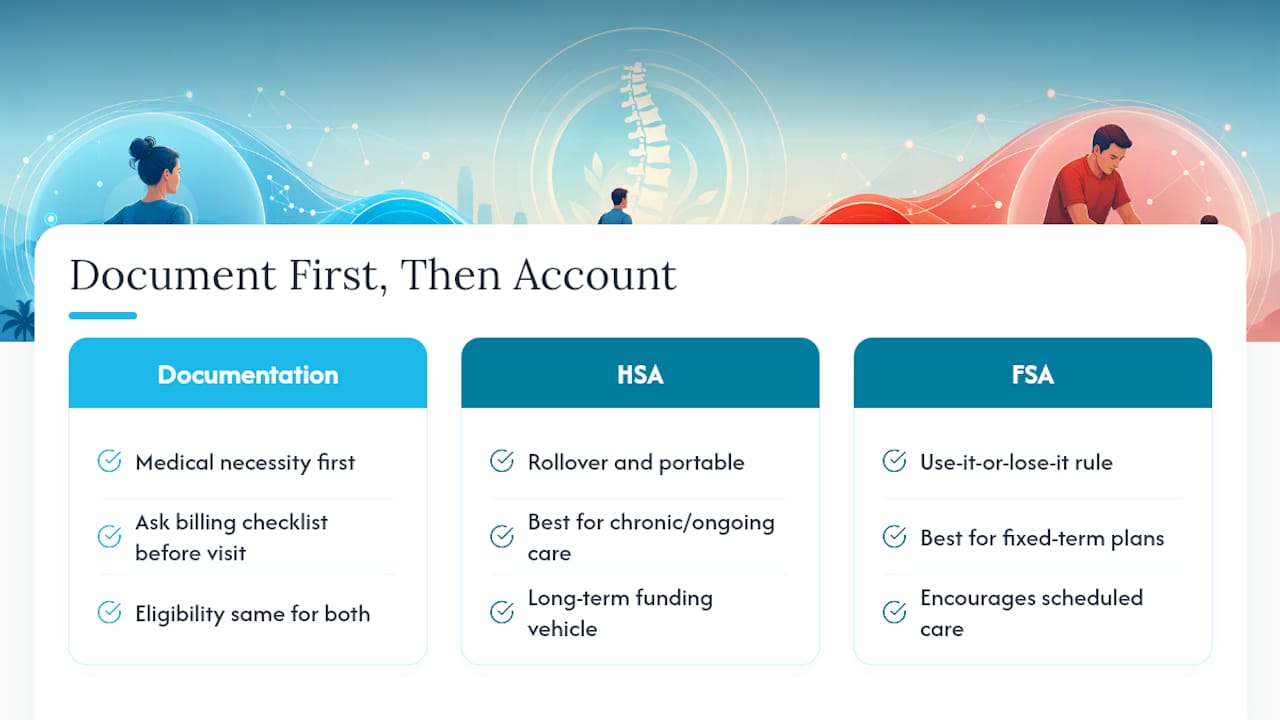
Document the medical necessity first. Then worry about which account to draw from. That’s the honest order of operations here, because eligibility rules are the same for both, but poor paperwork sinks a claim regardless of whose logo is on the card.
If your treatment plan runs a defined number of weeks, an FSA’s use-it-or-lose-it pressure can actually work in your favor by forcing you to schedule and finish care on time. If you’re managing something chronic or expect ongoing flare-ups for years, an HSA’s rollover and portability make it the better long-term vehicle. Ask your chiropractor’s billing team for their standard paperwork checklist before your first visit, not after a claim gets denied.
— Chris
Where to Verify HSA and FSA Chiropractic Rules Yourself
Check IRS Publication 502 for the medical-expense definition, Publication 969 for HSA-specific rules, and your plan provider’s own eligible-expense list, since FSA administrators can vary on specifics.
This article is general information, not a substitute for advice from a qualified financial advisor. Consult a qualified financial professional about your own circumstances before acting on anything here.
Sources
- Publication 502 (2025), Medical and Dental Expenses
- Fidelity: HSA and FSA eligible expenses (2025)
- Reimbursable: Is chiropractor treatment HSA/FSA eligible?
FAQ
Will FSA Pay for a Chiropractor?
Yes, FSA funds typically cover chiropractic visits when the care treats a diagnosed condition, following the same medical-care standard the IRS applies to HSAs under Publication 502. Confirm your specific plan’s eligible-expense list, since employers can set additional rules.
Why Would Anyone Use an FSA Instead of an HSA?
An FSA makes sense if you don’t have a high-deductible health plan, since HSA eligibility requires HDHP enrollment under Publication 969. It also suits people who know they’ll finish a short, defined treatment plan within the plan year and want the funds available immediately at the start of that year.
What Is Surprisingly HSA Eligible?
Beyond obvious medical bills, HSAs can cover items like orthotics, certain therapeutic massage tied to a diagnosis, and prescription supplements when a Letter of Medical Necessity documents the condition. The common thread is always a diagnosis behind the purchase, not the item itself.
Can I Use HSA for Chiropractic Adjustment?
Yes, chiropractic adjustments qualify as an HSA-eligible expense when they treat a diagnosed condition, per Publication 502’s medical-care definition. Keep an itemized receipt showing the date, provider, and service for your records in case your plan or the IRS asks for substantiation.
If you’re ready to start a documented treatment plan for pain, an old injury, or ongoing biomechanical issues, The Tx Room in Plano builds care plans around clear diagnoses and hands-on treatment through Deep Tissue Therapy Laser, Dry Needling, and Fascial Distortion Model techniques, the kind of documented approach that makes HSA and FSA reimbursement straightforward.