
Sciatica After Deadlifts: How to Recover and Lift Again
Yes, deadlifts can trigger sciatica. The mechanism is usually one of two things: a compressive load that irritates a disc and presses on a nerve root, or a soft-tissue response where the piriformis or surrounding glute musculature tightens and compresses the sciatic nerve directly. Either way, the first step is the same — stop heavy loading immediately and give the nerve room to calm down.
Here is what to do right now:
-
Put the bar down. No more loading until you can walk and sit without sharp radiating pain.
-
Find a position that reduces symptoms (often lying on your back with knees bent, or standing with a slight forward lean).
-
Short, pain-limited walks (5–10 minutes) are better than bed rest.
-
Ice the lower back or glute for 15–20 minutes if the pain is sharp and acute.
Red flag — go to the ER or urgent care now if you have: progressive leg weakness that is getting worse by the hour, numbness in the inner thighs or groin (saddle anesthesia), or any loss of bowel or bladder control. These signs suggest serious nerve compression that cannot wait for a clinic appointment.
Key Takeaways
Sciatica after deadlifts most often resolves with staged conservative care, but only when you stop loading early, follow a structured rehab progression, and address the technical faults that caused it.
| Point | Details |
|---|---|
| Stop loading immediately | Heavy deadlifts must stop at symptom onset; continuing loads the nerve and delays recovery. |
| Red flags need urgent care | Saddle numbness, progressive leg weakness, or bowel/bladder changes require emergency evaluation, not self-care. |
| Rehab follows three phases | Pain control (weeks 0–2), motor control (weeks 2–6), and progressive loading (weeks 6–12+) with no more than 10% weekly load increases. |
| Technique faults drive recurrence | Neutral lumbar spine, braced core, and bar close to the legs are the three cues that reduce nerve re-irritation on return. |
| Thetxroom offers hands-on care | FDM, myotherapy, and individualized return-to-lift programming at Thetxroom in Plano address both the nerve irritation and its mechanical cause. |
Table of Contents
-
Why deadlifts can cause sciatica: mechanisms worth understanding
-
What to do in the first 72 hours after sciatic pain from a deadlift
-
When to see a clinician: red flags, imaging, and treatment options
-
How Thetxroom in Plano assesses and treats sciatica after deadlifts
-
The pitfalls most lifters miss — and realistic recovery expectations
-
Thetxroom treats sciatica in athletes who want to get back to lifting
How does sciatica after deadlifts actually feel?
Knowing whether you have nerve pain or ordinary muscle soreness changes everything about how you respond. Sciatica from lifting typically produces a distinct pattern that muscle soreness does not:
-
Sharp or burning pain starting in the buttock or deep glute, sometimes radiating down the back of the thigh into the calf or foot
-
Numbness or tingling along the back of the leg, often described as a “pins and needles” sensation
-
Foot or ankle weakness, such as difficulty dorsiflexing the foot or pushing off on the toes
-
One-sided symptoms — sciatica almost always runs down one leg, not both
Contrast that with normal delayed-onset muscle soreness (DOMS), which typically peaks 24–48 hours after training, feels diffuse and bilateral, and does not radiate below the knee. Pain that shoots down the leg during or immediately after a lift points toward nerve involvement, not just muscle fatigue.
Pro Tip: Try a straight-leg raise at home: lie flat, keep the knee straight, and slowly lift the leg. If this reproduces your radiating leg pain below the knee, it raises suspicion for nerve root irritation and warrants clinical evaluation rather than self-managed stretching.
Why deadlifts can cause sciatica: mechanisms worth understanding
Disc-related nerve root compression
The deadlift places substantial compressive and shear forces on the lumbar spine, particularly at L4–L5 and L5–S1 — the two levels where the sciatic nerve roots most commonly originate. A sudden load spike, a rounded lower back under heavy weight, or cumulative overloading across sessions can provoke a disc bulge or herniation. When the disc material presses against a nerve root, the result is the classic radiating leg pain pattern. Incorrect heavy lifting is one of the more common precipitating events clinicians see for this presentation.
Piriformis and soft-tissue irritation
Not every case involves a disc. The sciatic nerve runs directly beneath (and in some people, through) the piriformis muscle in the posterior hip. Heavy deadlift sessions can leave the glutes and piriformis overworked and in spasm, which can compress or irritate the nerve without any disc pathology at all. Piriformis syndrome produces symptoms that closely mimic disc-related sciatica, which is why distinguishing the two matters for treatment.
Biomechanical contributors
Poor hip hinge mechanics are the most common technical fault that loads the lumbar spine incorrectly. Lumbar flexion under load, a bar path that drifts away from the legs, and a rapid jump in training volume all increase the mechanical stress on both the disc and the surrounding soft tissue. A study of national competitive deadlifters found that lumbopelvic injuries were the most common injury site in that population, underscoring how frequently this region bears the cost of technical or programming errors.
Lifting and sciatica risk: A longitudinal cohort study published in Scientific Reports found that lifting or carrying heavy objects at work was associated with a significantly higher risk of sciatica severe enough to require hospitalization, with body mass index and vibration exposure interacting to raise that risk further. The gym is a different context, but the mechanical principle is the same.
What to do in the first 72 hours after sciatic pain from a deadlift
The goal in the first three days is simple: reduce nerve irritation without creating deconditioning. Most people either do too much or too little.
Do:
-
Stop all heavy lower-body and spinal loading
-
Walk short distances (5–15 minutes) several times a day — movement keeps circulation going without compressing the nerve
-
Use ice (15–20 minutes) for acute sharp pain in the first 24–48 hours; switch to heat for muscle tightness once the acute phase settles
-
Take OTC NSAIDs (ibuprofen, naproxen) if medically appropriate — they address the inflammatory component, not just the pain signal
-
Sleep in a position that reduces symptoms, typically on your side with a pillow between the knees
Don’t:
-
Lie in bed for days — prolonged bed rest slows recovery and does not help nerve healing
-
Aggressively stretch the hamstrings or perform straight-leg raises that reproduce radiating pain; exercises involving strong hamstring or spine-flexion loading can worsen symptoms during an acute flare
-
Return to heavy deadlifts, squats, or any forward-flexion loading until symptoms are clearly improving
-
Assume the pain will resolve in a day and load up again on day two
Pro Tip: Pain that starts during the lift usually reflects mechanical overload — the disc or soft tissue was stressed beyond its tolerance in that moment. Pain that begins 6–24 hours later often reflects a delayed inflammatory response. Clinicians use that timing window as a clue when differentiating disc versus soft-tissue causes.
Repeat red flag: Progressive motor loss (foot drop, worsening leg weakness), saddle anesthesia, or new bowel/bladder dysfunction at any point in the first 72 hours means emergency evaluation — not a wait-and-see approach.
An actionable rehab progression from week 0 to week 12
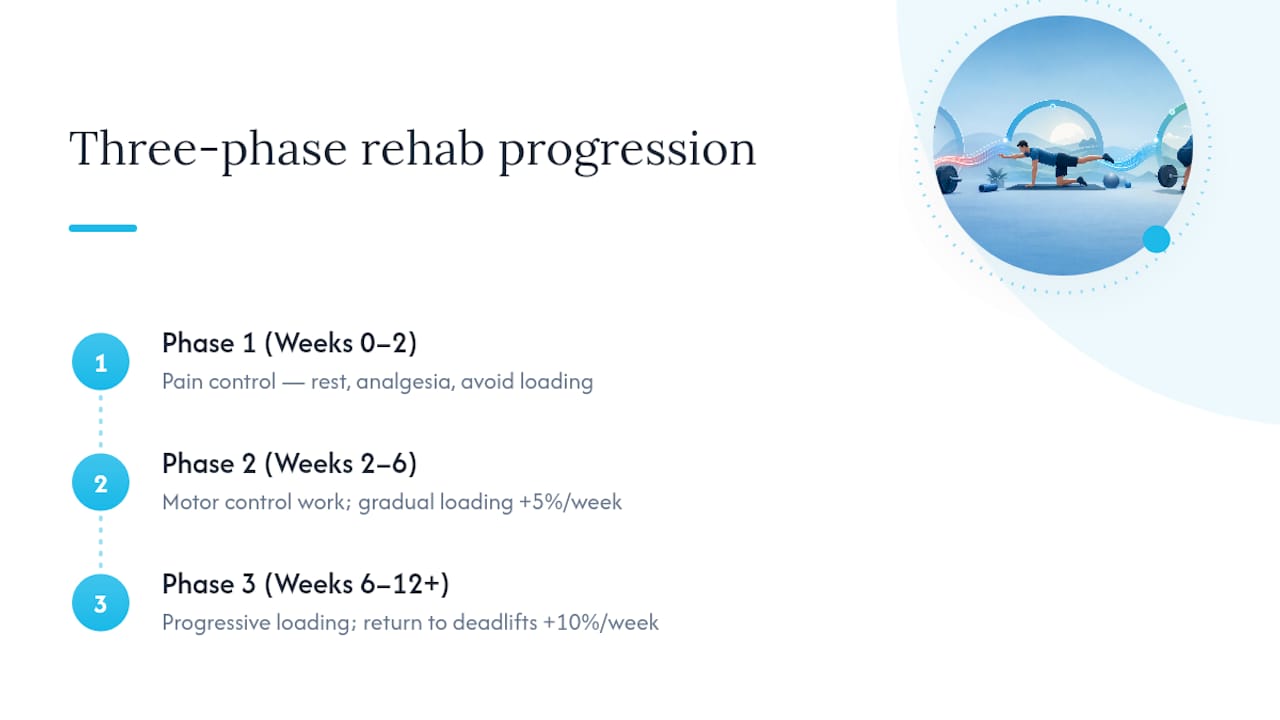
Recovery from sciatica after deadlifting is not linear, but it does follow a predictable sequence. Skipping phases is the most common reason people re-injure.
Phase 1: Weeks 0–2 (pain control and gentle activation)
-
Pain-limited walking, 2–3 times daily
-
Supine nerve glides: lying on your back, gently straighten the knee and dorsiflex the foot to the point of mild tension — hold 2 seconds, release; 10 reps per side, twice daily
-
Isometric glute sets: lying flat, squeeze the glutes for 5 seconds, release; 15 reps
-
Diaphragmatic breathing and gentle pelvic tilts for lumbar decompression
-
Avoid all loaded hip hinge movements
Phase 2: Weeks 2–6 (mobility, motor control, and early loading)
-
Progress nerve glides to seated and standing variations as symptoms allow
-
Clamshells, side-lying hip abduction, and banded hip external rotation for glute/piriformis strengthening — targeted exercises for piriformis-related symptoms are a core part of this phase
-
Bodyweight hip hinge drills (dowel on the spine, wall hip hinge)
-
Romanian deadlifts with a light kettlebell (start at a load that produces zero radiating symptoms), 3 sets of 8–10 reps
-
Dead bug and bird-dog progressions for core control
For athletes returning from injury, a mobility restoration checklist can help you track hip, hamstring, and thoracic range of motion benchmarks before advancing load.
Phase 3: Weeks 6–12+ (progressive loading and return to deadlifts)
-
Trap-bar deadlifts or conventional deadlifts at 50–60% of pre-injury working weight
-
3–4 week microcycles: increase load gradually per week, with a deload week every several weeks
-
Monitor for delayed-onset flares (pain appearing 8–24 hours after training) — these are the signal to reduce load or adjust technique, not push through
-
Reintroduce conventional deadlifts only after trap-bar and Romanian deadlift variations are pain-free and technically clean
| Phase | Weeks | Primary Goal | Sample Exercises |
|---|---|---|---|
| Pain control | 0–2 | Reduce nerve irritation | Walking, nerve glides, isometric glutes |
| Motor control | 2–6 | Restore movement patterns | Clamshells, bodyweight hinge, light RDL |
| Load restoration | 6–12+ | Return to progressive loading | Trap-bar DL, conventional DL at 50–60%, microcycle progression |
How to return to deadlifts safely after sciatica
The single biggest mistake lifters make is treating “no pain today” as clearance to go back to their pre-injury working weight. It is not.
Start with regressions:
-
Hip-hinge pattern drills with a dowel or PVC pipe before touching a barbell
-
Kettlebell deadlifts or trap-bar deadlifts — both reduce lumbar shear compared to a conventional barbell pull
-
Romanian deadlifts with controlled tempo (3-second lowering phase) to build posterior chain tolerance without maximal spinal loading
-
Paused deadlifts at the knee to reinforce position and eliminate momentum
Technique cues that protect the nerve:
-
Neutral lumbar spine throughout the pull — not hyperextended, not flexed
-
Braced core before the bar leaves the floor (think: 360-degree pressure, not just sucking in)
-
Bar stays in contact with the legs the entire way up; a drifting bar multiplies lumbar stress
-
Drive the hips through at lockout rather than hyperextending the lower back
ACE Fitness deadlift technique guidance emphasizes the hip hinge and bar-path control as the two most critical factors for protecting the lower back — both are worth drilling before adding load.
Programming rules for the return phase:
-
No more than 10% weekly load increase during the first 8 weeks back
-
Alternate heavy deadlift days with restorative sessions (light movement, mobility work, nerve glides)
-
Use autoregulation: if technique degrades or radiating symptoms return, that session ends
Pro Tip: Delayed-onset pain appearing 8–48 hours after a session is your most reliable feedback signal. A small flare that resolves within 24 hours is usually acceptable. Pain that lingers into the next training day means the load or volume was too high — reduce it by 20% and rebuild.
When to see a clinician: red flags, imaging, and treatment options
Self-care works for many uncomplicated cases, but there are clear thresholds where professional evaluation changes the outcome.
See a clinician if:
-
Radiating leg pain persists beyond 4–6 weeks despite modified activity and guided rehab
-
Leg weakness is worsening rather than improving
-
You cannot perform basic daily activities (walking, sitting for 20 minutes) without severe pain
-
Symptoms are bilateral (both legs)
-
Any red-flag neurologic signs are present
On imaging: MRI is not the first step for most acute presentations. Clinical guidance from NCBI Bookshelf recommends prioritizing conservative care first and reserving MRI for cases with progressive neurologic deficit or persistent radicular symptoms beyond 6–8 weeks. Early imaging rarely changes the initial management plan and can lead to unnecessary anxiety about findings that are often incidental.
Common treatment pathways and what to expect:
-
Physical therapy: Targeted exercise, manual therapy, and movement retraining. Most uncomplicated cases improve meaningfully within 6–12 sessions over 4–8 weeks.
-
Chiropractic care: Hands-on spinal and soft-tissue treatment, particularly useful for athletes with biomechanical contributors. Sports-spine chiropractors can also guide return-to-lift programming directly.
-
Medications: Short-term NSAIDs or muscle relaxants for acute flares; oral corticosteroids occasionally for severe radicular pain.
-
Epidural steroid injections: Considered when conservative care over 6–12 weeks has not produced adequate relief; can reduce inflammation around the nerve root.
-
Surgery: Reserved for cases with persistent neurologic deficit, disc herniation causing intractable pain, or cauda equina syndrome. The vast majority of sciatica cases do not reach this point.
Emergency signs — act immediately: Foot drop that develops suddenly, rapidly worsening bilateral leg weakness, or any loss of bowel or bladder control require an ER visit, not a scheduled appointment. These presentations can indicate cauda equina syndrome, which is a surgical emergency.
How Thetxroom in Plano assesses and treats sciatica after deadlifts
Thetxroom uses a structured intake process designed specifically for athletes presenting with exercise-related nerve pain. Here is what the assessment and treatment flow typically looks like.
Assessment protocol:
-
Detailed mechanism-of-injury history: when symptoms started, what movement triggered them, and how they have changed since
-
Neurologic screen: manual muscle testing for key myotomes (hip flexion, knee extension, ankle dorsiflexion, great toe extension), reflex testing, and dermatomal sensory mapping
-
Movement analysis: the clinician observes the patient’s hip hinge pattern, identifies lumbar flexion faults, and assesses hip external rotator mobility and glute activation quality
Treatment outline:
-
Fascial Distortion Model (FDM) techniques: hands-on manual therapy targeting the specific fascial distortions contributing to nerve irritation and movement restriction
-
Myotherapy for the piriformis, glute complex, and lumbar paraspinals to reduce soft-tissue compression on the nerve
-
A progressive home exercise plan that mirrors the rehab phases above, adjusted to the patient’s specific presentation
-
Collaborative return-to-lift programming with objective criteria for each stage (load, range of motion, symptom thresholds)
Anonymized case example:
A recreational powerlifter presented with left-sided buttock and posterior thigh pain that began during a heavy conventional deadlift session. Neurologic screen showed mild weakness in ankle dorsiflexion and a positive straight-leg raise at 45 degrees on the left. Over 7 treatment sessions across 6 weeks, FDM and targeted myotherapy reduced the soft-tissue compression component, and a graded exercise progression moved the patient from bodyweight hip hinges to trap-bar deadlifts at 60% of prior working weight. By session 7, the straight-leg raise was negative and the patient returned to conventional deadlifts with a modified warm-up protocol and a 10% weekly load cap.
What to bring to your first visit: a description of the lift that triggered symptoms, your current training program, and any prior imaging if available. The first session includes the full assessment, a short hands-on treatment, and a take-home exercise plan. You can schedule your appointment here.
The pitfalls most lifters miss — and realistic recovery expectations
Most lifters who struggle with recurring sciatica after deadlifts share a few common patterns. They return to full load the moment pain subsides, treating symptom resolution as structural recovery. Those are not the same thing. A nerve that has been irritated needs time to restore normal conduction and the surrounding tissue needs time to rebuild tolerance — pain going away is the beginning of that process, not the end.
The other consistent mistake is over-relying on passive treatments without progressive loading. Manual therapy and soft-tissue work reduce irritation and restore mobility, but they do not rebuild the posterior chain strength and motor control that protect the nerve under load. Both are necessary. Neither alone is sufficient.
One finding worth noting: the competitive deadlifter study found that longer static stretching before training correlated with higher lumbopelvic injury incidence. Long static holds before a heavy session may reduce the tissue stiffness that protects the spine under load. A dynamic, movement-based warm-up is a better choice.
Realistic timeline: most uncomplicated soft-tissue cases improve meaningfully in 4–6 weeks with guided rehab. Disc-related nerve root compression takes longer, often 8–12 weeks, and a small percentage of cases need advanced interventions. Persistent symptoms beyond 6 weeks without improvement are a clear signal to escalate to clinical evaluation rather than continuing to self-manage.
Thetxroom treats sciatica in athletes who want to get back to lifting
If you have been dealing with radiating leg pain after deadlifts and home management has not moved the needle, hands-on care changes the trajectory faster than rest alone.
Thetxroom in Plano, Texas, specializes in exactly this presentation: exercise-related sciatica in athletes who want a clear path back to training, not just a prescription to stop lifting. The clinic uses the Fascial Distortion Model and targeted myotherapy to address both the nerve irritation and the soft-tissue contributors that keep it from resolving, paired with a progressive return-to-lift plan built around your actual training goals.
The first visit covers a full neurologic and movement screen, a short hands-on treatment, and a take-home exercise progression you can start the same day. Most athletes with uncomplicated presentations see meaningful improvement within 4–6 sessions. For disc-related cases, the timeline is longer, but the approach is the same: restore function, rebuild tolerance, return to the bar.
For back pain and sciatica care in Plano, schedule your initial evaluation and get a clear picture of what is driving your symptoms and what it takes to fix it.
Sources
The following sources informed this guide and are worth reading directly if you want clinical depth on any specific area:
-
Lifting heavy boxes may have triggered sciatica | UCLA Health
-
Incidence and risk factors of sports injuries among national competitive deadlifters
-
Lower back pain after deadlifts: causes and prevention tips – Hinge Health
This article is general information, not a substitute for advice from a qualified doctor. Consult a qualified healthcare professional about your own circumstances before acting on anything here.